- Flooring
LVP vs. Laminate in Montana: Which One Handles Montana Winters Better?
August 26, 2026
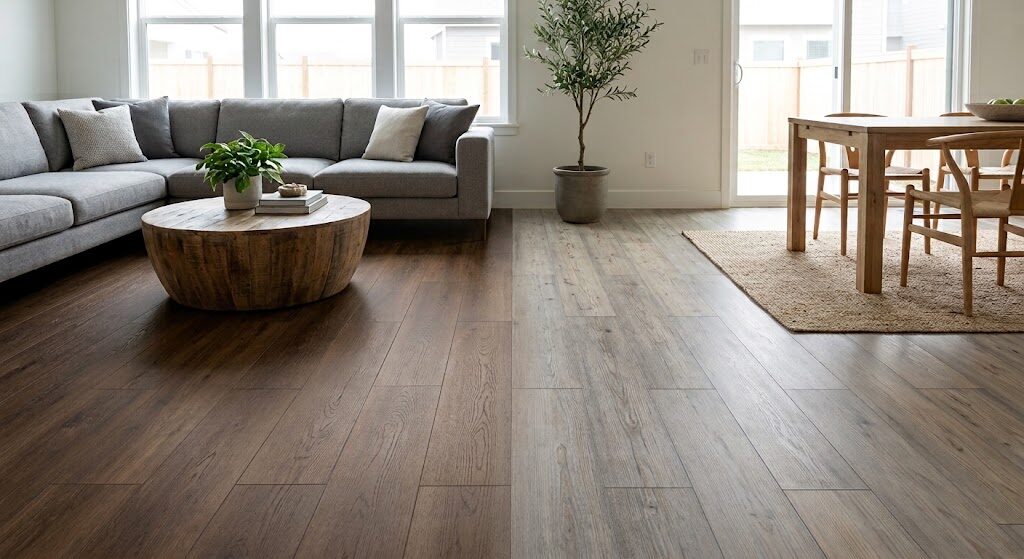
Walk into a Billings home improvement conversation and you’ll hear both of them mentioned in the same breath. LVP. Laminate. They both look like wood. They both cost less than engineered hardwood. And they’re close enough in price at certain tiers that the decision feels like a coin flip.
It isn’t.
The gap between LVP and laminate is not about appearance or price. It’s about what happens when Montana walks in the door — mud from April snowmelt, road salt on boots in January, a dog shaking off a winter run across the kitchen floor. One product handles that without consequence. The other has a limit.
Stop by the showroom at 2032 Grand Ave or call (406) 656-2824 and bring a photo of the rooms you’re working on. In most cases, the right answer is clear within 15 minutes of the conversation.
What LVP and Laminate Actually Are
Before comparing performance, it helps to understand what each product is made of.
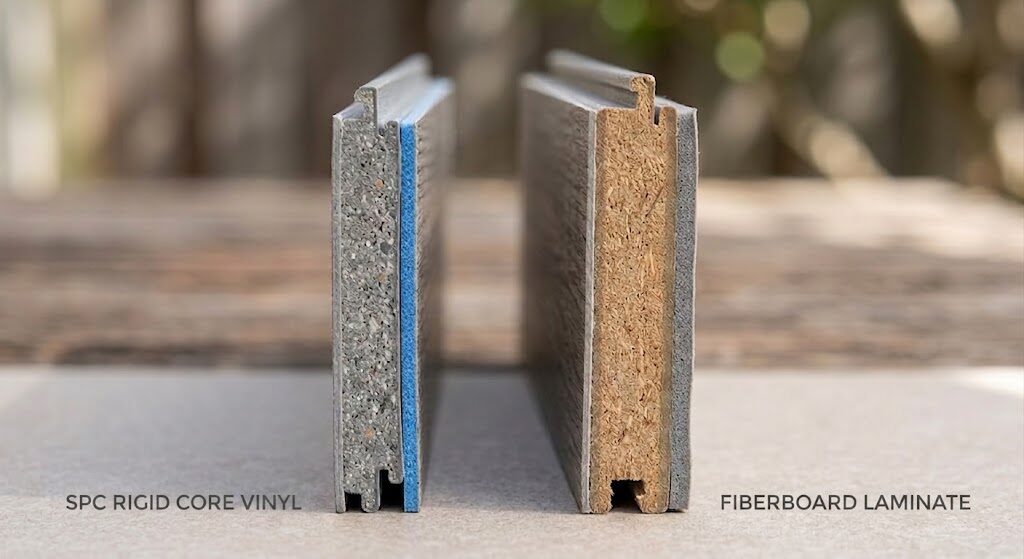
Luxury vinyl plank (LVP) is a fully synthetic flooring product. From the backing to the wear layer on top, it contains no wood fiber. The core — either SPC (stone polymer composite) or WPC (wood polymer composite) — is 100% waterproof. Water cannot penetrate the product, damage the core, or cause the plank to swell, buckle, or separate at the seams. Modern emboss-in-register technology aligns surface texture with the printed grain pattern to create a convincingly realistic wood appearance.
Laminate is primarily a wood-fiber product. The decorative layer on top is a photographic film sealed under a hard wear layer — visually similar to LVP, and often indistinguishable at a glance. But the core beneath is high-density fiberboard (HDF), a wood-based material that absorbs moisture. Standard laminate uses a click-lock profile that does not have a watertight seal — water enters through the seam and reaches the HDF core within minutes of contact, causing it to swell. Waterproof laminate uses a wax-sealed or polymer-coated locking system and a sealed core that resists water penetration for up to 24-72 hours per manufacturer specifications — far better than standard laminate, but not equivalent to LVP’s complete waterproofness.
That distinction is the entire comparison in one paragraph. Everything else is detail.
LVP vs. Laminate: The Montana Winter Test
Billings homes face a specific moisture challenge that product specifications don’t always account for.
From November through March, Billings Public Works applies road salt and sand to streets and sidewalks. That material gets tracked indoors daily on boots, paws, and shoes. In the kitchen entryway, the mudroom, and anywhere near an exterior door, the floor sees road salt, meltwater, and grit in combination — repeatedly, for months.
Beyond tracked-in moisture, Montana spring thaw creates brief but real flooding risk in some older Billings homes. A backed-up floor drain, a basement entry that takes on water, a washing machine connection that fails — low-probability events that become high-consequence ones if the floor cannot handle standing water.
LVP handles all of that without consequences. Wipe it up, let it dry, move on. The product does not care about moisture.
Waterproof laminate handles surface moisture well and resists normal tracked-in moisture effectively. Where it meets its limit is prolonged standing water — an actual flood, or a recurring source like a pet bowl knocked over daily in the same spot. Standard laminate should not go in any room where moisture is a regular factor in a Billings home.
Room by Room in a Billings Home: Which Product Wins Where?
The practical way to navigate this decision is room by room.
Kitchen: LVP wins. Moisture exposure is routine — spills, steam, tracked-in moisture from the exterior door, pets. Waterproof laminate is defensible for kitchens with no flooding history and careful homeowners, but LVP is the lower-risk option with no performance trade-off in this application. For LVP upkeep tips specific to Montana conditions, see the vinyl care and maintenance guide at cbarn.com.
Living room and dining room: Both are viable. Neither sees the moisture exposure that makes LVP’s waterproof advantage decisive. The choice comes down to budget and preference. Laminate often delivers a slightly warmer, denser underfoot feel. LVP offers the same visual range with complete moisture protection.
Bedrooms: Both are viable. Bedrooms see almost no moisture exposure. The decision is entirely about comfort, aesthetics, and budget.
Mudroom and entryway: LVP wins. This is where a Montana home takes the most direct daily abuse — wet boots, road salt, dogs and kids coming in from outside. Standard laminate should not be in a mudroom. Waterproof laminate can work but is a riskier choice than LVP for this application.
Basement: LVP wins. Below-grade installation over a concrete slab is an LVP application. See the Carpet Barn guide to best flooring for Billings basements for the full picture on below-grade flooring in Montana.
Bathroom: LVP wins. Tile is also an excellent choice for bathroom floors. Laminate — standard or waterproof — is not appropriate in bathroom applications with regular moisture exposure.
SPC vs. WPC: The LVP Core Decision That Matters in Montana
If you decide on LVP, there’s one more specification that matters more in Billings than it does in most markets: the core type.
SPC (stone polymer composite) cores have a lower thermal expansion coefficient — around 0.05% — compared to WPC (wood polymer composite) at approximately 0.08%. In a Montana home that cycles between a heated interior in winter and ambient temperatures during unheated periods, SPC maintains its dimensional stability more reliably. It also installs more predictably over concrete subfloors, which are common in Billings homes.
WPC-core LVP has a foamed polymer core that provides a warmer, more cushioned underfoot feel and better sound absorption than the denser SPC core. It’s a reasonable choice for bedrooms and above-grade living rooms in well-controlled environments — provided the floor is not installed over a concrete slab, where WPC’s slightly higher expansion rate can create gapping issues in Montana’s seasonal temperature cycle.
“The SPC vs. WPC question comes up on almost every LVP project we do. For most Billings homes — especially anything with a concrete subfloor or an exterior entry nearby — SPC is the right call. The stability difference is real when you’re dealing with Montana winters.” — World Famous Carpet Barn team, Billings, MT
An Honest Assessment of Waterproof Laminate
Waterproof laminate has improved significantly over the past several years and deserves a fair evaluation rather than a blanket dismissal.
Quality waterproof laminate from a reputable manufacturer delivers a visual quality and underfoot feel that many homeowners find more convincing than LVP in the wood-look category. The density of the HDF core creates a sound and feel when walked on that is closer to real wood than the acoustic quality sometimes associated with thinner LVP planks.
For a Billings homeowner specifying flooring for a living room or dining room — areas that see normal household use with no flooding history and careful spill management — waterproof laminate is a legitimate option with excellent visual results.
The honest limitation: it has a threshold. LVP does not. In any room where Montana weather is coming in the door, or where water on the floor is a realistic scenario rather than a careful-homeowner hypothetical, LVP is the more appropriate choice.
Where to Find LVP and Laminate at Clearance Pricing in Billings
Once you’ve narrowed down the product, the next step for most Billings homeowners is finding the right tier and price point. The Carpet Barn special buys section is worth knowing about before you start shopping.
The Grand Ave showroom maintains a rotating selection of LVP and laminate at factory direct clearance pricing — inventory that changes monthly and often includes first-quality product from discontinued runs, overstocks, and closeout programs. Many of these deals are available in-store only. Browse special buys and clearance flooring at cbarn.com for the current online selection, then confirm what’s in stock at the showroom. Clearance product sells on a first-come basis.
“Purchased laminate flooring for our new build. Astasia was wonderful at handling our project and helping us every step of the way! She’s amazing at her job and we recommend her!” — Renee C., Billings homeowner
“Great service, got a lot of different carpets to choose from in our price range. Installation was excellent.” — Ray S., Billings homeowner
How to Make the Call for Your Billings Home
If you’re standing in a showroom trying to choose between LVP and laminate, run through these questions.
Does any room on the project involve an exterior entry, moisture source, pet water area, or below-grade space? If yes, LVP for those rooms — no further deliberation needed.
Is budget the primary driver, and are the rooms all above-grade interior living areas with no moisture history? Waterproof laminate is a defensible option and worth comparing side by side at the showroom.
Do you want to eliminate the moisture question entirely from the decision? LVP, across the board.
“We see a lot of Billings homeowners come in thinking the decision is mostly about looks and price. Once we walk through the rooms and the household — dogs, kids, exterior entries, what the winters are actually like on that street — the right answer usually becomes clear pretty quickly.” — World Famous Carpet Barn team, Billings, MT
Browse the vinyl flooring collection and the laminate collection at cbarn.com, or stop by the showroom at 2032 Grand Ave. Free in-home consultations and estimates are available — call (406) 656-2824.
Frequently Asked Questions
What is the main difference between LVP and laminate flooring?
LVP is a fully synthetic product with a waterproof core from top to bottom — it contains no wood fiber and water cannot damage it. Laminate has a high-density fiberboard (HDF) core that is wood-based. Standard laminate will swell when water reaches the core through its click-lock seams. Waterproof laminate resists this for up to 24-72 hours per manufacturer specs, but is not equivalent to LVP’s complete waterproofness.
Which is better for a Montana home: LVP or laminate?
For rooms where Montana weather is coming in the door — kitchens, mudrooms, entryways, basements — LVP is the better choice. For above-grade living rooms, dining rooms, and bedrooms with no moisture exposure, both are viable. LVP eliminates the moisture variable entirely; waterproof laminate manages it with conditions.
Can laminate flooring be used in a Billings kitchen?
Waterproof laminate can work in a Billings kitchen with no flooding history and careful spill management. Standard laminate should not be in a kitchen — the moisture exposure will eventually compromise the HDF core. LVP is the lower-risk choice for any Montana kitchen where boots, pets, and spills are part of daily life.
What is SPC-core LVP and why does it matter in Montana?
SPC (stone polymer composite) is a rigid, dense LVP core with a lower thermal expansion coefficient (around 0.05%) than WPC (wood polymer composite) at approximately 0.08%. In Montana’s climate — with significant seasonal temperature variation — SPC maintains dimensional stability better than WPC. Carpet Barn recommends SPC-core LVP for most Billings applications, particularly over concrete subfloors or in rooms near exterior entries.
Does laminate feel more like real wood than LVP?
Quality waterproof laminate often delivers an underfoot feel that many homeowners find closer to real wood than LVP, because the HDF core is denser and creates a more wood-like acoustic quality when walked on. Thicker LVP planks with WPC cores have closed this gap, but laminate still has a slight edge in perceived authenticity in the feel category for some homeowners.
Is LVP or laminate better for a Billings home with pets?
LVP is generally the better choice for Billings homes with pets. It handles pet water bowls, accidents, and tracked-in mud and moisture without damage. Laminate’s moisture sensitivity makes it a higher-risk choice anywhere a pet regularly interacts with the floor near water sources.