- Flooring
Best Flooring for Pets in Montana: What Holds Up Against Dogs, Cats, and Montana Mud
May 29, 2026
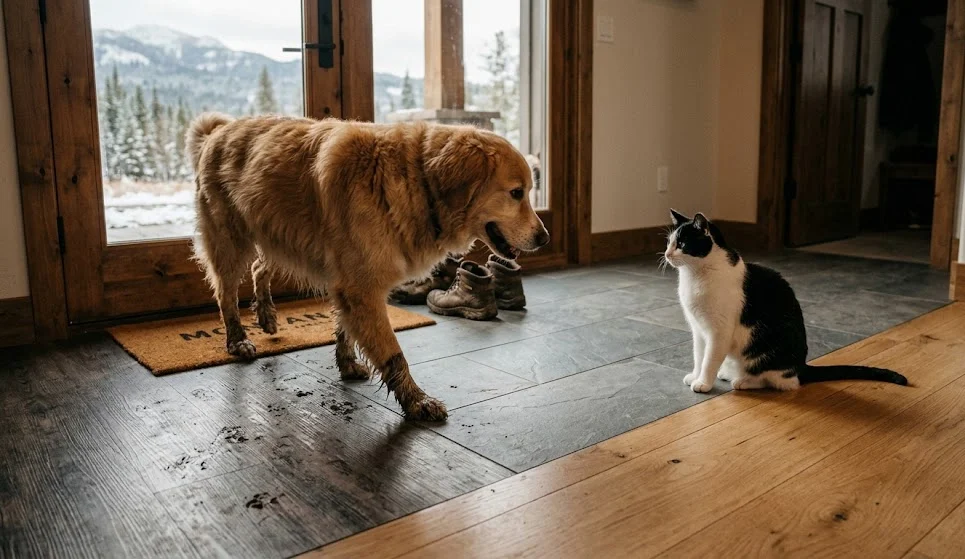
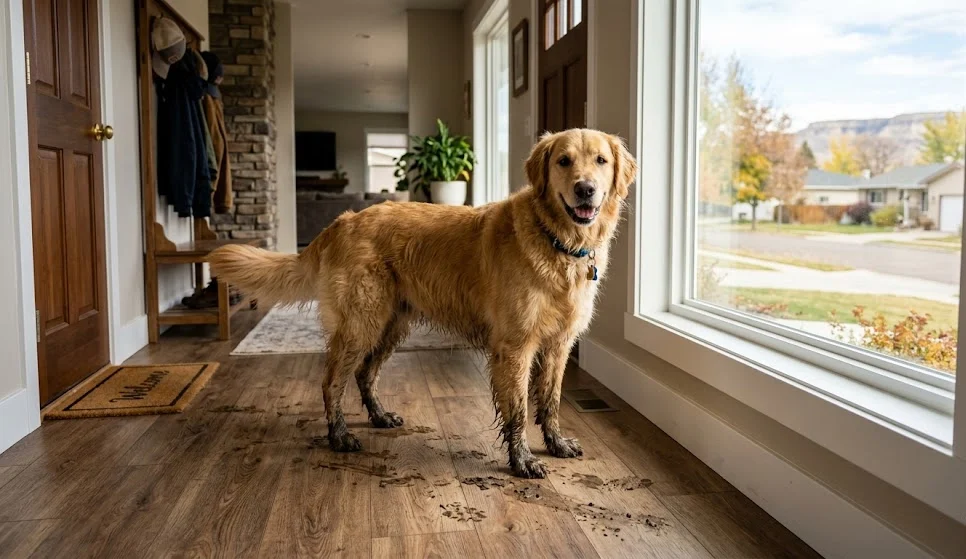
Your dog just came in from the backyard in Billings, paws coated in Yellowstone County clay, and dragged a trail from the back door to the living room. If that image makes you wince about your current floor, you already know why you are reading this.
No floor is genuinely pet-proof. The goal is finding the most resistant option for your specific household, your dog’s size and habits, and the seasonal reality of a Montana winter that drops indoor humidity below 25% for months at a time. That last detail is one most national pet-flooring guides skip entirely — and it matters more than most people realize for LVP performance.
This guide covers what actually holds up, where the marketing claims fall short, and which products the Pierce Flooring team in Billings recommends most often for homes with pets. Schedule a free in-home estimate or stop by our Billings showroom on King Avenue West — no appointment needed.
Why Montana Pet Flooring Is a Different Problem Than the Rest of the Country
Most national pet-flooring guides compare scratch ratings and waterproof claims without accounting for what happens when indoor humidity drops below 25% for four straight months — which is exactly what Billings homes experience between November and February without active humidification.
Here is what that means in practice. LVP flooring, even the waterproof kind, relies on click-lock joints to stay flat and tight. When indoor humidity stays very low for extended periods, the planks contract slightly and stress those joints. An LVP floor installed with proper acclimation and expansion gaps handles this fine. One that was rushed handles it less well, developing small edge separations — exactly where pet urine and muddy water infiltrate most easily.
Montana’s mud season compounds this. From late March through early May, Billings yards produce the kind of sticky clay mud that adheres to paws and carries abrasive grit indoors. That grit acts like sandpaper on any flooring with a soft wear layer. The scratch resistance rating on a product’s spec sheet is tested in a lab, not on Rimrock-area red clay in late April with a 70-pound lab mix running across it.
For Montana households with hunting dogs, ranch dogs, or large working breeds that spend time outdoors in all seasons, this seasonal wear cycle is the real durability test — not the standardized scratch test.
Pro-Tip from the Pierce Flooring Billings Team: When a customer tells us they have two large dogs and a mudroom entry point, we ask what the floor sees daily — not just accidents, but running starts, grit from outdoor paws, and skid landings on slick surfaces. Traction matters as much as scratch resistance, and most pet-flooring guides skip it. We consistently recommend textured or low-sheen finishes for households with dogs over 40 pounds. Matte and satin finishes outperform high-gloss in hiding micro-scratches and providing paw grip.
The Real Comparison: LVP, Engineered Hardwood, and Tile for Montana Pet Households
Luxury Vinyl Plank and SPC — The Most Popular Choice, With Caveats
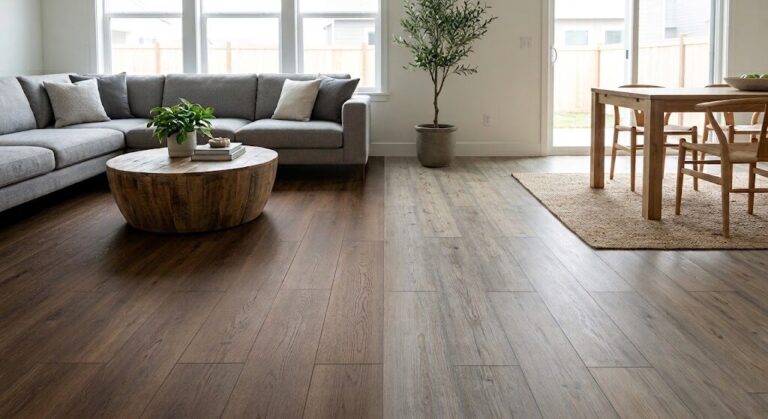
LVP is the floor most Billings pet owners choose, and for good reason. It is 100% waterproof at the surface, scratch-resistant, and available in finishes that hide daily wear. The caveats are worth knowing before you commit.
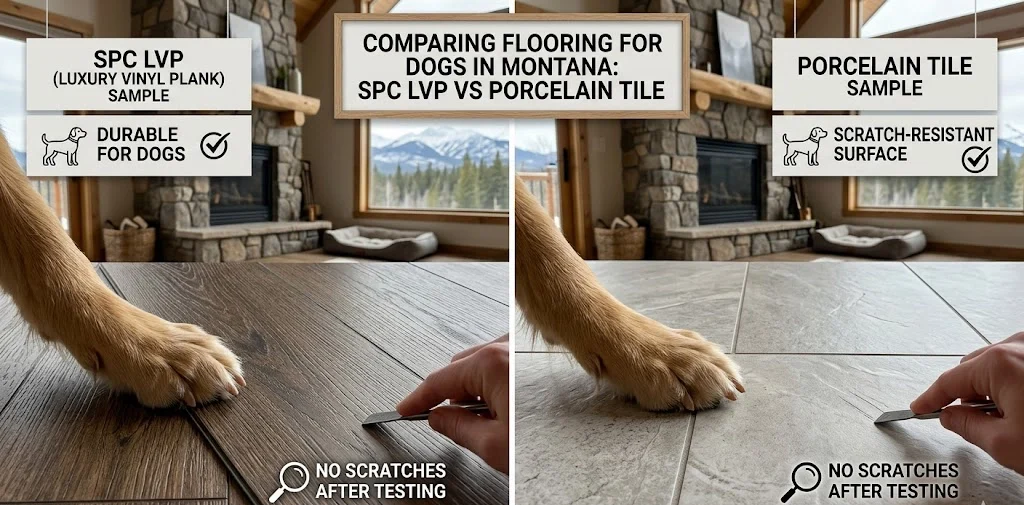
Wear layer thickness is everything for pet households. A 12-mil wear layer is adequate for a single small dog with clipped nails. Two large dogs with outdoor access in a Montana home need at least a 20-mil wear layer. Below 20 mil, repeated claw drag across gritty paws will mark the surface within a season. The Pierce team consistently recommends Mohawk and Cali SPC collections that hit that threshold.
SPC (rigid-core LVP) is the better choice for Montana specifically. Its rigid limestone-infused core holds dimensional stability through the state’s humidity swings better than standard flexible-core LVP. For a household where the front door opens onto a muddy yard multiple times a day, that stability advantage compounds over time. LVP needs 24-48 hours of acclimation before installation; SPC’s rigid core typically requires the full 48 hours in Montana’s dry winter conditions before installation begins.
The waterproof claim is real for surface accidents cleaned up promptly. What can infiltrate is liquid that sits at a seam or edge gap for an extended period. Proper installation with tight seam alignment matters as much as the product’s waterproof rating.
Engineered Hardwood — For the Pet Owner Who Will Not Compromise on Aesthetics
Engineered hardwood is not the obvious choice for a pet household, but it is not off the table. Anderson Tuftex produces collections with hard-species veneers and multi-coat aluminum oxide surface treatments that perform meaningfully better than soft-species or single-coat-finish hardwood under daily claw traffic. Factory finish quality varies by product tier — multi-coat aluminum oxide finishes offer substantially better protection than single-coat for a pet household.
The honest conversation starts with species hardness. White oak and hickory veneers hold up better than pine or walnut. The Janka hardness scale (NWFA) gives you a concrete benchmark — hickory at 1820, white oak at 1360, and walnut at 1010. Keep in mind that Janka describes the species, not the veneer thickness. A 2mm hickory veneer over a plywood core is more scratch-resistant than a 2mm walnut veneer, but deep claw marks can still reach the core regardless of species. Wear layer protection and finish type complete the picture alongside species hardness.
Engineered hardwood is not the right choice for a home with an incontinent dog or a puppy in training. It is a reasonable choice for trained adult dogs in a home where aesthetics matter — particularly with a hard species and factory multi-coat finish.
Tile — The Right Answer for Mudrooms and High-Traffic Entry Zones
Porcelain tile is the most durable surface a Montana dog household can put near an exterior door. Scratch-proof, waterproof, and impervious to mud, it handles everything the worst mud season can deliver. For a dog household, look for a wet coefficient of friction (COF) above 0.60 on any tile near exterior doors — that is the ANSI standard for slip-resistant surfaces and a practical benchmark for wet paw traction.
The Pierce team frequently recommends a tile mudroom entry paired with SPC LVP in the main living areas. The transition makes practical sense: tile absorbs the worst of the outdoor mess, and the LVP picks up from there once paws are cleaner.
What About Laminate?
Honest answer: we do not recommend laminate for a Montana pet household’s primary living spaces. The surface is scratch-resistant, but the core is not waterproof. An accident that reaches the seam causes swelling in the fiberboard core. Montana’s low-humidity winters also stress laminate at the seams. It works well in low-traffic, low-moisture environments — not on a pet household’s main floor.
“The office staff was friendly and answered all our questions. Ryan and Dexter were great. They were efficient and finished in a timely manner with good follow up to make sure all was right. I appreciated how they cleaned up when they finished. Of course we love the new floor!!!! Before was linoleum, now it’s LVP!”
Billings Homeowner — LVP Installation
Keeping Your Pet-Friendly Floor Looking Good in Montana’s Seasons
The mud season maintenance routine for an LVP floor in a Billings pet household is simple but specific. A mat at every exterior entry point traps the first 80% of grit before it reaches the floor. Sweep daily during mud season, not weekly. Grit that sits on an LVP surface and gets walked across repeatedly by paw traffic does more cumulative damage than any one accident.
For cleaning pet accidents, use a pH-neutral enzyme-based pet cleaner. Avoid anything with citrus solvent, bleach, or Murphy’s Oil Soap — the last one surprises most pet owners, but Murphy’s is formulated for wood floors and leaves a residue on LVP that dulls the finish over time. It is not pH-neutral for vinyl surfaces.
For engineered hardwood in a pet household, keep indoor humidity between 35-55% year-round. In a Billings winter, that means running a humidifier. The National Wood Flooring Association (NWFA) specifies this range for hardwood stability, and it also happens to be the range where pet-related seasonal gapping is least likely. Keep dog nails trimmed — long nails drag across the veneer on every step.
One detail that surprises most pet owners: high-gloss LVP finishes show paw prints, nose smears, and scratches more than matte finishes. If you are choosing between the same product in gloss and matte, matte will look cleaner longer in a pet household — not because it is more durable, but because it hides the daily evidence better.
“I had a great experience shopping for new flooring at Carpet Barn. Friendly service and great prices. I purchased LVP flooring for my kitchen and can’t wait to have it installed. Would recommend the kind and helpful employees at the Billings store.” Edith H. – LVP
Source: WorldFamous Carpet Barn Billings GBP
Choosing the Right Installer for a Montana Pet-Household Floor
A pet-household floor is only as good as the installation underneath it. Ask any installer these questions before signing.
Do they allow proper acclimation time? SPC needs 48 hours of acclimation minimum in Montana’s dry winter conditions. Skipping acclimation increases the chance of seam separation later — which is exactly where pet accidents infiltrate.
Do they specify a moisture barrier for slab construction? For Billings homes in neighborhoods like Lockwood and the Westend, a properly rated vapor barrier is the right foundation for any floating LVP or SPC installation.
What is their seam alignment practice? For pet households, tight seam alignment reduces infiltration surface area. Ask what their quality check process looks like before they pack up.
At Pierce Flooring, every installation begins with an in-home measurement and assessment. The Pierce Promise covers installation errors for one year after install and supports manufacturer warranty claims for the life of the product. Pierce Flooring has served Montana since 1924 — over 230 employees, eight locations statewide.
Frequently Asked Questions
What is the best flooring for dogs in a Montana home?
SPC rigid-core LVP with a 20+ mil wear layer is the most practical choice for most Montana dog households. It handles surface accidents, resists Montana mud grit better than softer wear layers, and holds dimensionally stable through the state’s low-humidity winters. Pair it with porcelain tile at exterior entry points for the highest-traffic muddy zones.
Is LVP actually waterproof for pet accidents?
At the surface, yes. A pet accident cleaned up within a reasonable time does not penetrate the wear layer. The risk is liquid that sits at a seam or edge gap for an extended period, where it can work into the click-lock joint. Proper installation with tight seams and correct acclimation practice reduces this risk significantly. A 20+ mil wear layer also increases the time window before surface penetration becomes an issue.
What flooring hides pet scratches best?
Matte and satin-finish LVP hides micro-scratches better than high-gloss finishes. Wire-brushed or hand-scraped engineered hardwood also conceals claw marks effectively because the distressed surface texture absorbs scratches into the overall visual pattern. High-gloss finishes show every mark and are not recommended for active dog households.
Can engineered hardwood work in a Montana pet household?
Yes, with the right species and finish. Hard-species veneers like hickory (1820 Janka) or white oak (1360 Janka) with factory multi-coat aluminum oxide finishes hold up better than soft-species or single-coat options. Engineered hardwood is not recommended for households with puppies in training or incontinent pets, but it is a reasonable choice for trained adult dogs where aesthetics matter.
Does Montana’s winter humidity affect pet flooring performance?
Yes, directly. Billings’ indoor humidity regularly drops below 25% in winter without humidification. This causes LVP click-lock joints to contract slightly, increasing seam gaps — exactly where pet urine and mud penetrate most easily. Running indoor humidity between 35-55% year-round reduces this risk significantly and is within the NWFA’s recommended range for wood floor stability. A whole-home or room humidifier from November through February makes a measurable difference.
Ready to Find the Right Floor for Your Montana Pet Household?
There is no single perfect pet floor. There is the right floor for your specific pets, your home’s entry points, your Montana climate zone, and your maintenance tolerance. The Pierce Flooring team in Billings works through that conversation with every customer before recommending anything.
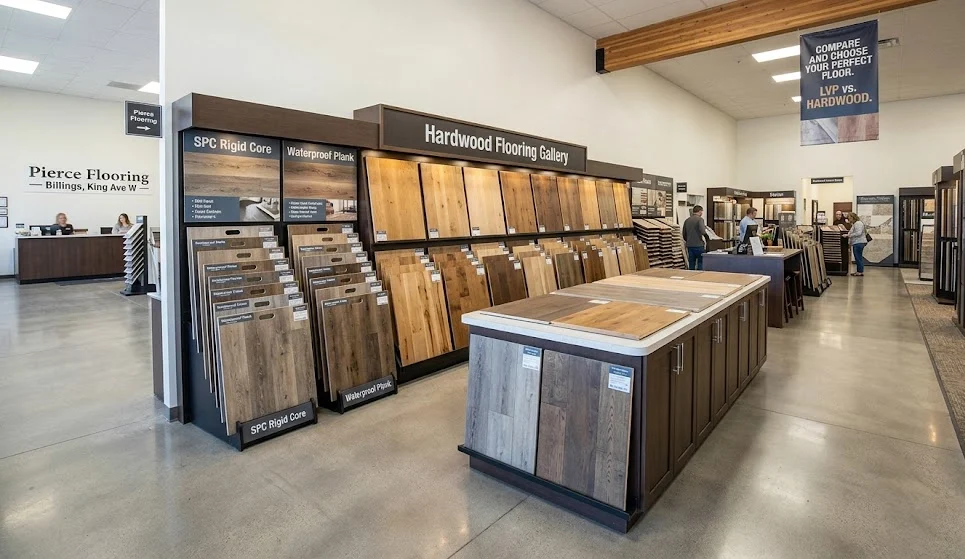
Stop by our showroom at 2950 King Ave West in Billings any weekday or Saturday — no appointment needed. See the Mohawk and Cali SPC collections side by side, feel the difference in wear layer thickness, and ask the questions that online reviews cannot answer. Try our Roomvo Room Visualizer before you visit to see how different floors look in your actual space.
Carpet Barn – Flooring & Cabinets in Billings, Montana
2032 Grand Avenue, Billings, MT 59102
Monday through Friday, 7:30 AM to 6 PM. Saturday, 8:30 AM to 5 PM.
Browse LVP and SPC options | Browse engineered hardwood | Schedule a free in-home estimate