- Flooring
Sheet Vinyl vs. LVP in Billings Kitchens: Which One Actually Holds Up?
May 12, 2026
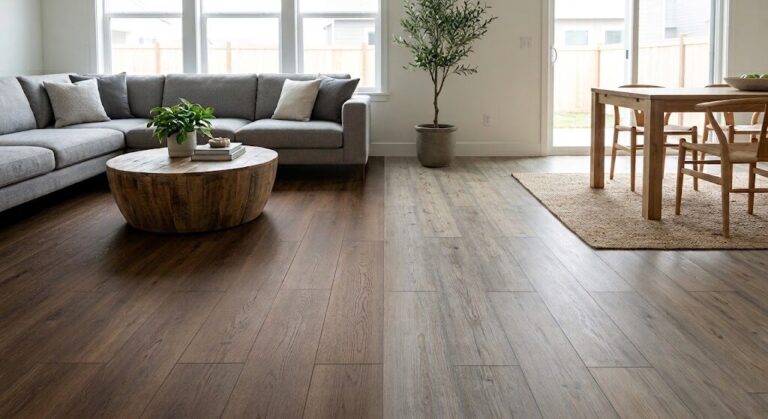
Your Billings kitchen floor is under more stress than most flooring specs anticipate.
Most homeowners comparing sheet vinyl vs. LVP for their kitchen focus on price and looks.
Those matter.
But in a Billings home, the more important question is: which product handles that 40-point humidity swing without failing at the seam or the edge?
The answer depends on your subfloor, your kitchen layout, and how much foot traffic that room actually takes.
Our team at Carpet Barn has installed both products across Billings Heights, the West End, Laurel, and Lockwood. Here is what we have learned about which wins in each scenario. Book a Free In-Home Measurement this week — we come to you, no appointment needed.
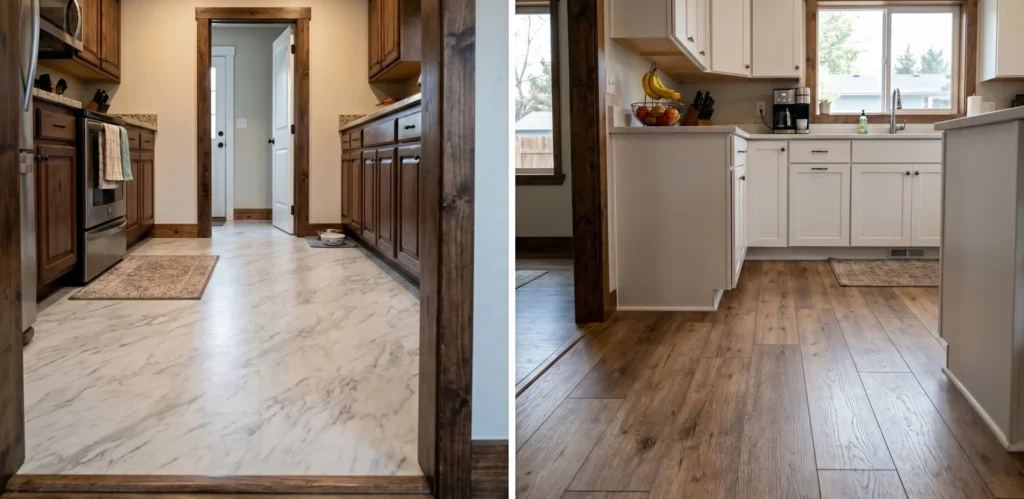
Why Billings Kitchens Are Different From the Rest of the Country
The Rimrocks that define Billings’ skyline sit above a geology that creates a specific kind of subfloor challenge.
Billings Heights and West End neighborhoods are dominated by slab-on-grade construction built between the 1970s and 1990s. Those slabs sit in Yellowstone County’s predominantly clay-heavy soils, which expand when wet and contract when dry.
That soil movement cycles the concrete surface seasonally. Whatever flooring you lay on top moves with the slab whether it wants to or not, and the joints and adhesive bonds are where the damage shows up first.
NOAA Climate Normals data for Billings Logan International Airport puts average annual precipitation around 14 inches. The more relevant number for your kitchen floor is the indoor humidity range: heated Montana homes in December and January commonly drop to 15 to 22 percent relative humidity indoors without supplemental humidification.
Both NOAA and ASHRAE flag that range as outside comfort-zone conditions for most building materials, and it shows up in our service calls: sheet vinyl lifting at dishwasher seams, LVP planks gapping at their long edges, adhesive bonds releasing at the perimeter.
In a Billings Heights or West End slab-on-grade kitchen, moisture is the first question, not the last.
A concrete slab in this climate wicks ground moisture upward year-round, regardless of whether the homeowner has ever seen standing water. That vapor migration is why we run a moisture assessment before every kitchen install.
Pro Tip from the Carpet Barn Team
In Billings Heights slab kitchens, we consistently measure moisture emission rates of 3 to 5 lbs per 1,000 sq ft per 24 hours in late winter and early spring. That is above the 3 lb threshold most sheet vinyl adhesives are formulated for. Slabs testing above that level require a moisture-mitigation coating or epoxy vapor barrier primer applied before the adhesive layer. We test before we quote, not after the floor starts lifting.
Sheet Vinyl vs. LVP: The Real Comparison for Montana Kitchens
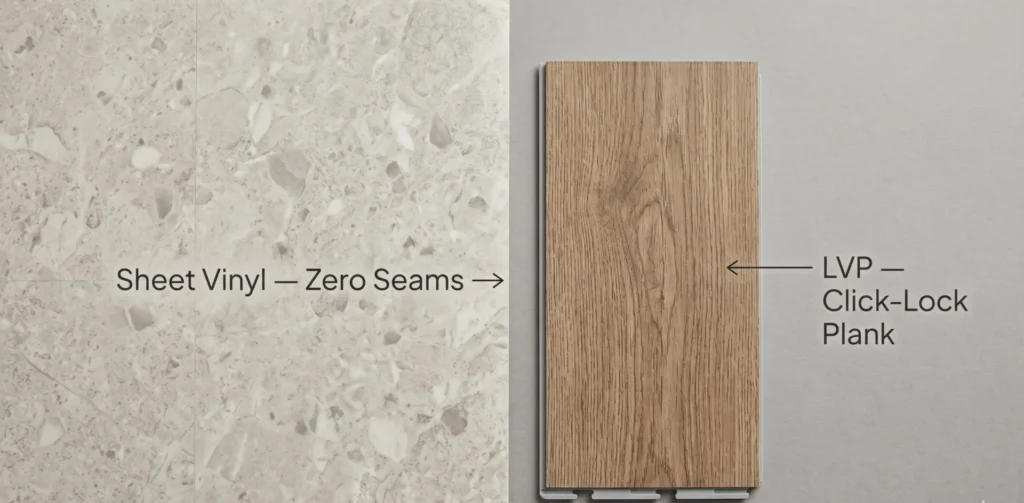
Here is the thesis, stated plainly: both products are 100 percent waterproof at the surface.
The real difference is coverage.
Sheet vinyl is waterproof across the entire floor because it has no seams. LVP is waterproof at each individual plank, with joints between them.
In a Billings kitchen, that distinction drives every other decision.
Sheet Vinyl: The Seamless Moisture Argument
Sheet vinyl comes in rolls, typically 6 or 12 feet wide, which means most kitchens can be covered in a single piece with zero seams across the traffic zone.
No seams means no entry point for spilled water, dishwasher overflow, or pet accidents to reach the subfloor.
For a kitchen that sees high daily moisture exposure, that is a genuine structural advantage, not just a marketing point.
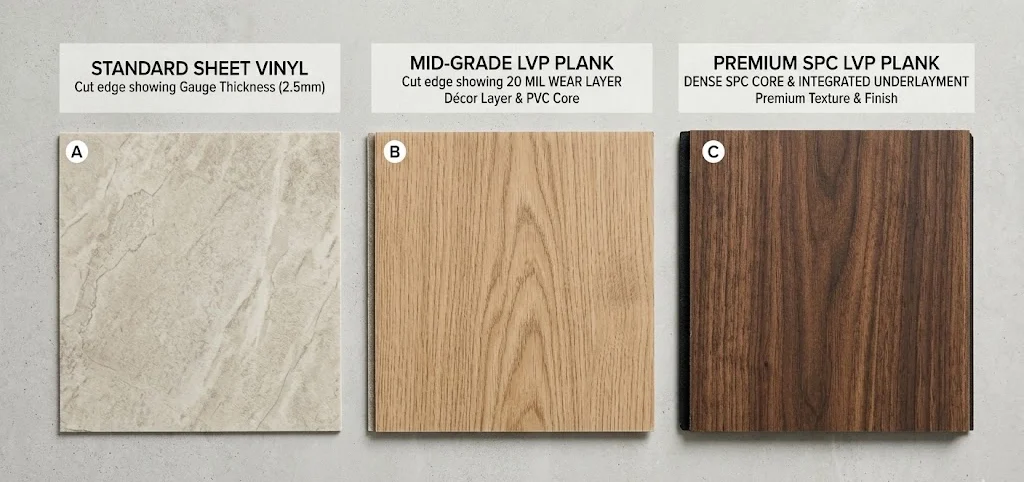
Modern sheet vinyl has improved significantly since the resilient flooring of the 1970s and 1980s that most homeowners picture. Products with a 0.055 inch or thicker wear layer offer solid scratch resistance for a kitchen with pets or kids.
Cushioned-back options add underfoot comfort for cooks who stand for long periods, and the checkerboard and terrazzo-look patterns seeing a design revival in 2026 are almost exclusively available in sheet form, not plank.
That said, sheet vinyl is harder to repair. A tear or gouge requires cutting out a section and patching with a seam visible under raking light. It is also heavier, demands a flat and thoroughly adhered subfloor, and installation is not a realistic DIY project in most Billings homes.
Any subfloor irregularity, old tile grid lines, fastener heads, skim-coated seams in older slab kitchens, telegraphs through the sheet within 12 to 18 months. We see this constantly in Billings Heights, where previous vinyl tile layers were patched rather than removed decades ago, and those ridges show through the new floor within a year.
LVP: The Modular Durability Argument
Luxury vinyl plank clicks together over a floating installation, which means it expands and contracts as a unit rather than being glued down at every point.
In Billings’ humidity-cycling climate, that floating behavior is actually an asset: the floor can move slightly without popping seams the way a fully adhered sheet can. The critical requirement is maintaining expansion gaps at every wall and transition, confirmed from your specific product’s installation guide, not a generic standard.
SPC (stone-plastic composite) core LVP handles temperature swings better than earlier WPC (wood-plastic composite) predecessors. Most SPC products are warranted for installation and service in spaces that maintain between 55°F and 85°F.
Before installing in a kitchen that may drop below that threshold in a Montana winter power outage, confirm the specific product’s temperature range.
The Resilient Floor Covering Institute (RFCI) maintains installation guidelines for temperature and humidity ranges, and we use those specs when recommending a product for a specific kitchen.
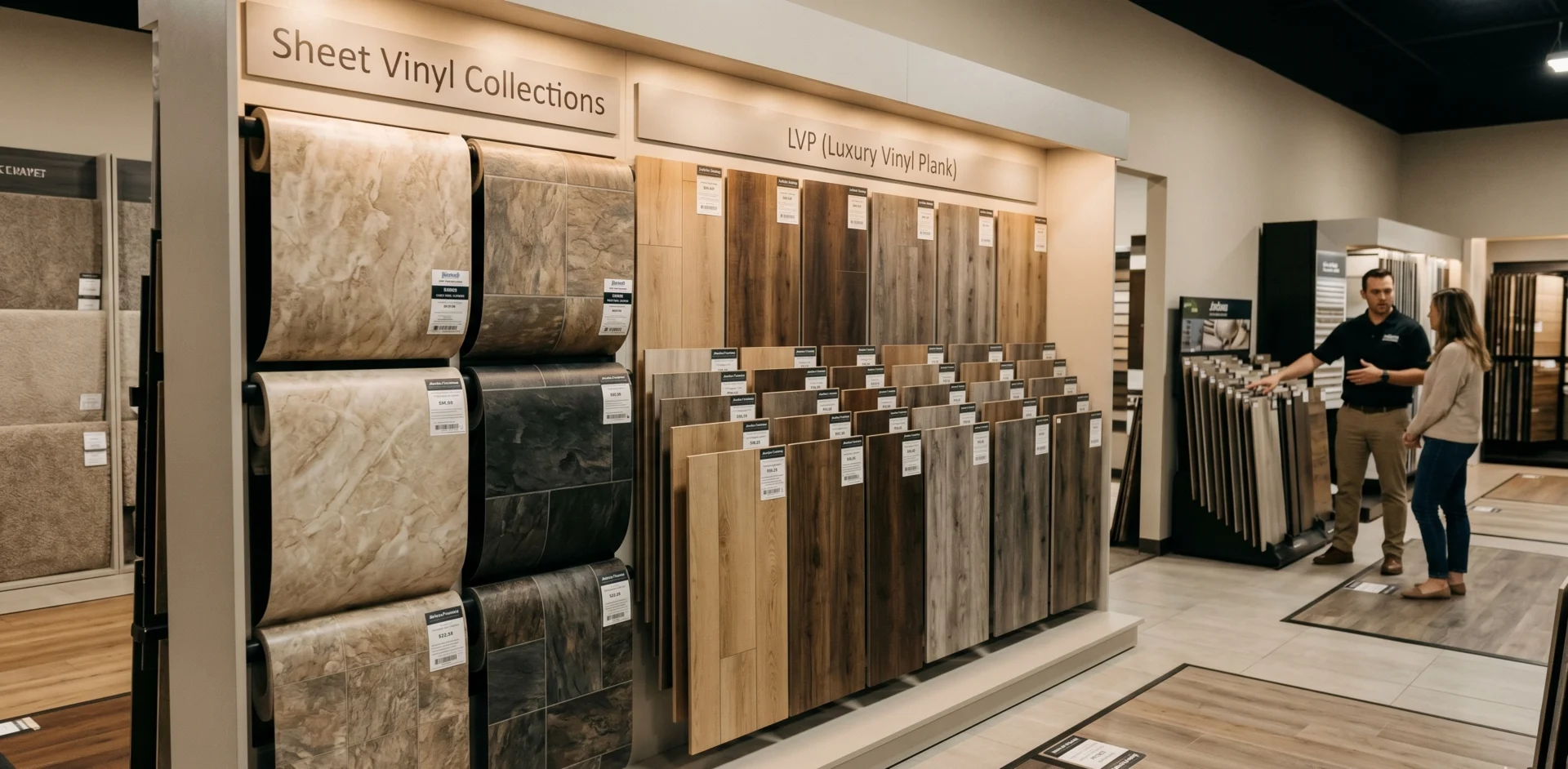
The honest tradeoff: every plank joint is a potential entry point for water if a spill sits long enough. Seam sealer applied to the cut plank edges during installation, before clicking the next plank into place, reduces this risk significantly but does not eliminate it. Post-install surface application is ineffective and can leave visible residue on the wear layer finish.See our full vinyl flooring selection at cbarn.com, or visit the showroom to compare plank and sheet samples side by side. Carpet Barn carries Shaw’s SPC-core LVP collections as an authorized Shaw dealer — ask about what is currently in stock.
“These people are incredibly helpful, kind, and patient. Great selection, fantastic prices. Very good advice on color coordination and appropriate flooring types for different applications.”
Billings Homeowner | Vinyl Flooring Selection & Installation
What Sheet Vinyl and LVP Actually Cost in Billings, MT
Now, about installation costs — this is where it gets interesting. Most Billings kitchen flooring projects cover 150 to 300 square feet of actual floor area. The table below uses Billings-area regional contractor pricing and HomeAdvisor local cost data for Montana for 2025 to 2026.
What drives price variation in Billings specifically: subfloor prep is the biggest variable and the most commonly underestimated one. Clay soil movement creates low spots and high spots in slab-on-grade kitchens that require floor leveling compound before either product goes down, adding $1.00 to $2.50 per square foot in labor and material. Sheet vinyl installations demand more thorough surface prep because any imperfection telegraphs through lower-gauge products. Removal of existing vinyl tile or sheet adds another $0.50 to $1.00 per square foot, and pre-1986 installations may require asbestos testing before removal begins.
Want a quote built around your actual kitchen? Book a Free In-Home Measurement at Carpet Barn — we come to you, assess your subfloor, and quote the full project on the spot.
“Honestly, the subfloor conversation is the one most homeowners skip until after the floor goes down. On a slab-on-grade kitchen in the Heights or West End, it is the only conversation that actually matters. The product choice is secondary to what you are laying it on.”
Mario DeLaCruz, Flooring Specialist — Carpet Barn
“Sheet vinyl and LVP both get called waterproof flooring, and both are, at the surface. What I always ask a customer first is: how many seams are between your kitchen and a spill event? With sheet vinyl, the answer is zero. With LVP, it is one per plank joint. For most Billings kitchens, that seam count is what decides the conversation.”
Mario DeLaCruz, Flooring Specialist — Carpet Barn
Living With Your Kitchen Floor: What Changes Over Time
Most homeowners never think about their kitchen floor again after installation day. Here is what actually happens to it over time in a Montana home, and where most of the post-install calls we get originate.
Sheet vinyl’s seamless surface is genuinely easy to clean, but the edges and transition seams are where moisture damage accumulates. Check those edges once a year. A lifted edge left unaddressed through a Billings mud season allows moisture under the product and can take years off the floor’s life. Avoid steam mops on any vinyl product: the heat degrades the adhesive bond, softens the wear layer, and voids most manufacturer warranties on both sheet vinyl and LVP. If a warranty claim comes up later, evidence of steam mop use is grounds for denial.
LVP behaves differently over the same seasonal cycle. Billings’ low winter humidity causes SPC cores to contract slightly, which is exactly why expansion gaps at walls and transitions matter. A floor installed without proper gaps in October may develop audible popping or buckling in March as the slab warms and humidity returns. According to the Resilient Floor Covering Institute (RFCI), floating LVP should maintain an expansion gap confirmed by the specific product’s installation guide at all fixed vertical surfaces. We verify gap compliance on every install before sign-off.
One maintenance mistake specific to vinyl kitchen floors: placing rubber-backed area rugs directly on LVP or sheet vinyl. The rubber’s plasticizers migrate into the PVC wear layer over time, causing permanent discoloration that looks like a stain but cannot be cleaned away. The fix is simple. Use felt-backed or vinyl-safe rug pads under any area rug on a vinyl surface.
For daily cleaning, use only a pH-neutral vinyl floor cleaner. Vinegar solutions and citrus-based cleaners are acidic and will dull the urethane finish on LVP wear layers over time, even if the change is gradual. The damage is cumulative and irreversible, and it is the single most common avoidable maintenance mistake we hear about after the fact.
“Work complete timely, expertly and just as promised. Would highly recommend.”
Billings Homeowner | Flooring Installation
How to Choose a Flooring Installer for Your Billings Kitchen
Both sheet vinyl and LVP are forgiving products when installed correctly. They are genuinely unforgiving when they are not. Before you commit to any flooring contractor in Billings, here is what to ask.
- A subfloor moisture assessment should happen before any quote. On a slab-on-grade kitchen in Billings Heights or the West End, a moisture reading is not optional. The calcium chloride test (ASTM F1869) and the probe method (ASTM F2170) each require 24 to 72 hours of slab exposure to run properly. Any contractor quoting a slab kitchen without a site visit is not accounting for the most expensive variable in the project.
- Confirm what leveling compounds they use. For Yellowstone County clay-heavy slab-on-grade kitchens, self-leveling compounds rated for exterior moisture exposure outperform standard patching compounds when the slab shows seasonal cycling.
- Ask about the expansion gap specification for the exact product you are purchasing. Gap requirements vary by manufacturer and collection, not by a universal standard. A gap that is correct for one SPC product may be wrong for another.
- Get installation warranty terms in writing. A real warranty specifies what failures are covered, for how long, and whether installation-caused failures are distinguished from material defects.
- For sheet vinyl installations specifically, ask whether they perform a test cut and dry-fit before adhesive application. This step catches seam placement problems before they become permanent.
In our experience installing both products across Billings Heights and West End slab-on-grade kitchens, moisture-related sheet vinyl adhesive failures consistently outpace LVP floating-floor failures when slabs have not been moisture-tested before installation. The test takes less than 72 hours. The remediation, when it is needed, costs far less than reinstallation.At Carpet Barn, our professional, insured installers operate under the Pierce Promise, which provides direct customer advocacy if any material or installation issue arises after the job is complete. Our team carries over 180 years of combined flooring experience across sales, design, and installation. We carry both sheet vinyl and LVP in ranges from entry-level to commercial grade, and we can show you both in the showroom before you decide.
“The real question for a Billings kitchen is not which product is better in general. It is which product is better for your subfloor, your traffic level, and your tolerance for repair complexity. Those three answers together almost always point clearly to one option.”
Mario DeLaCruz, Flooring Specialist — Carpet Barn
Frequently Asked Questions
How much does sheet vinyl vs. LVP cost installed in a Billings kitchen?
For a standard 200 square foot Billings kitchen, heavy-duty sheet vinyl (0.055 inch wear layer) runs $700 to $1,200 installed, depending on subfloor prep requirements. Mid-grade LVP with an SPC core runs $900 to $1,400 for the same footprint. The gap narrows once subfloor leveling and moisture barrier requirements are factored in, which are common on slab-on-grade construction in Billings Heights and the West End. Get an in-person quote. Subfloor conditions in this market shift project costs more than the product choice does.
Does Billings’ humidity cycling affect sheet vinyl and LVP differently?
Yes, meaningfully. Sheet vinyl, being fully adhered, transfers the seasonal expansion and contraction of the slab into the product perimeter and seams. If the adhesive bond is inadequate for the moisture emission rate of the slab, the edges lift. LVP, being a floating floor, can move slightly as a unit, which accommodates the Billings humidity swing better in most cases. However, LVP must have proper expansion gaps, confirmed from the manufacturer’s installation guide for that specific product, or the floor will buckle when it expands in spring.
Is sheet vinyl good for kitchens with dogs and high daily traffic?
Sheet vinyl with a 0.055 inch or thicker wear layer handles dog nails and heavy foot traffic well. The advantage over LVP in high-traffic households is the seamless surface: there are no joints for dog nails to catch on or for spilled water to work into. The tradeoff is repairability. A gouge in sheet vinyl requires a patch repair, while a damaged LVP plank can be replaced individually without disturbing the surrounding floor. For households with multiple large dogs and a slab subfloor, we typically recommend sheet vinyl. Where design flexibility and easier repairs matter more, mid-grade or premium LVP is usually the stronger choice.
Can the wrong expansion gap void my LVP warranty?
Yes, and it happens more often than most Billings homeowners realize. Expansion gap requirements vary by product. Most SPC products specify 1/4 inch to 1/2 inch depending on plank width and product design. Installing without the correct gap, or against a fixed vertical surface like a cabinet base, can cause buckling that the manufacturer will attribute to improper installation rather than a product defect. Always confirm the gap specification from your product’s installation guide before the crew starts, not after the floor goes down.
What maintenance mistakes shorten vinyl kitchen floor life the most in Montana?
Three are particularly common here. Steam mops are the biggest offender: they void manufacturer warranties on both sheet vinyl and LVP and degrade the adhesive bond on sheet installations. Rubber-backed area rugs are the second: the rubber’s plasticizers migrate into the PVC wear layer and cause permanent discoloration that no cleaner will remove. The third is using vinegar or citrus-based cleaners, which are acidic and progressively dull the urethane finish. All three are easy to avoid. Use a pH-neutral vinyl cleaner, felt-backed rug pads, and a mop that does not use steam.
Ready to Choose the Right Kitchen Floor for Your Billings Home?
The sheet vinyl vs. LVP decision gets straightforward once we look at your actual subfloor, your kitchen’s traffic pattern, and your priority between seamless waterproofing and design flexibility. Our team at Carpet Barn can walk through all three in about fifteen minutes, and we carry a full range of both products for side-by-side comparison.
Before you come in, try visualizing different vinyl styles in your actual kitchen with our Room Visualizer at cbarn.com. It only takes a minute and helps narrow the conversation considerably. Ask about our 0% financing options: a subfloor prep and product upgrade that adds $400 to a project looks very different on a zero-interest payment plan.
Carpet Barn is an authorized Shaw dealer, a member of the National Flooring Alliance, and holds a BBB A+ rating. Those credentials reflect more than 50 years at the same Billings address.
World Famous Carpet Barn
2032 Grand Avenue, Billings, MT 59102 | (406) 656-2824
Monday–Friday 7:30 AM to 6:00 PM | Saturday 8:30 AM to 5:00 PM
Serving Billings since 1972. Part of the Pierce family of Montana businesses since 1924.