- Flooring
5 Signs It’s Time to Replace Your Flooring in Billings, MT
March 12, 2026
Most floors in Billings don’t give out all at once. They signal the problem months, sometimes years, before the real damage sets in. The trouble is, those signals are easy to explain away. “That creak was always there.” “The gap is just from winter.” “The carpet will look fine once we vacuum.”
Here’s the reality: Billings outdoor humidity swings from 76% in January down to 40% in August, but inside a heated home in January that number drops far lower, often below 25%, which is where floors start to suffer. That extreme seasonal swing is one of the widest in the inland West, and it puts every wood-based flooring product in your home through a full expansion-and-contraction cycle every single year. Add the tracked-in road salt from November through April, the UV index that climbs hard at our elevation above 3,000 feet, and the clay-heavy Haverson and Bainville soils common under Yellowstone County homes, and you have conditions that age floors faster here than in most of the country.
The five signs below aren’t generic. They’re the patterns our team at World Famous Carpet Barn sees in Billings homes, season after season. If more than one applies to your floors right now, it’s worth getting a free estimate before the small problem becomes a subfloor problem.
Schedule Your Free Consultation or stop in any day this week at 2032 Grand Avenue.
Sign 1: Your Wood Floors Are Gapping in Winter and Swelling in Spring
A small amount of seasonal movement in hardwood is normal. A consistent gap you can slip a coin into, boards that cup along the edges each spring, or planks that feel spongy underfoot — those are different conversations.
Billings winters are dry. Indoor humidity in a heated home can fall below 20% from December through February. The National Wood Flooring Association recommends keeping indoor humidity between 35% and 55% for solid hardwood. Most Billings homeowners are running well below that floor for three to four months straight, which means the wood is losing moisture it won’t fully reclaim until late spring.
Boards shrink across the grain, gaps open at the seams, and over multiple cycles the finish checks and the tongue-and-groove joints wear loose. Think of it as your floor taking a deep breath every winter and exhaling every spring — except after enough cycles, it can’t fully exhale anymore.
Spring brings the opposite problem. Snowmelt means wet boots, wet dogs, and wet entryway traffic from February through April. If moisture is getting under the boards, you’ll see cupping, where board edges rise above the center, a sign that moisture is migrating up from below.
The opposite pattern, crowning, where the center rises higher than the edges, typically indicates surface moisture from wet mopping or a leak above. Both require attention. Cupping caught early can sometimes be reversed with proper drying and humidity management. Cupping that’s been there two or three cycles usually means the board has taken a permanent set.
Pro-Tip Callout — World Famous Carpet Barn Flooring Team In the Heights and Lockwood neighborhoods, we see subfloor moisture readings consistently higher than in the West End, partly because of the grade and drainage patterns in those areas. Before we install anything in those neighborhoods, we always run a full moisture assessment first. A floor that looks dry on top is not always dry at the subfloor.
The honest answer on gapping: if the gaps close fully in summer and the boards are still structurally sound after five or more years, you may be managing normal movement. If the gaps stay open year-round, if the finish is lifting at the seams, or if the boards flex when you walk on them, the floor has passed the point where refinishing will help. Explore our hardwood flooring options and bring in your measurements for a free estimate.
Sign 2: Your Carpet Has Matted Sections That Won’t Recover
Carpet has a lifespan, and in a Billings home, that lifespan is shortened by factors most people don’t account for. Road salt tracked in from October through April embeds deep in carpet fibers and acts as a slow abrasive. High-altitude UV from our sunny summers degrades fiber structure faster than in lower-elevation cities.
The dry indoor air common in Billings winters creates static that pulls fine particulates into the carpet at the fiber root, where vacuuming can’t reach them. Over time, those particles act like sandpaper on every fiber they touch.
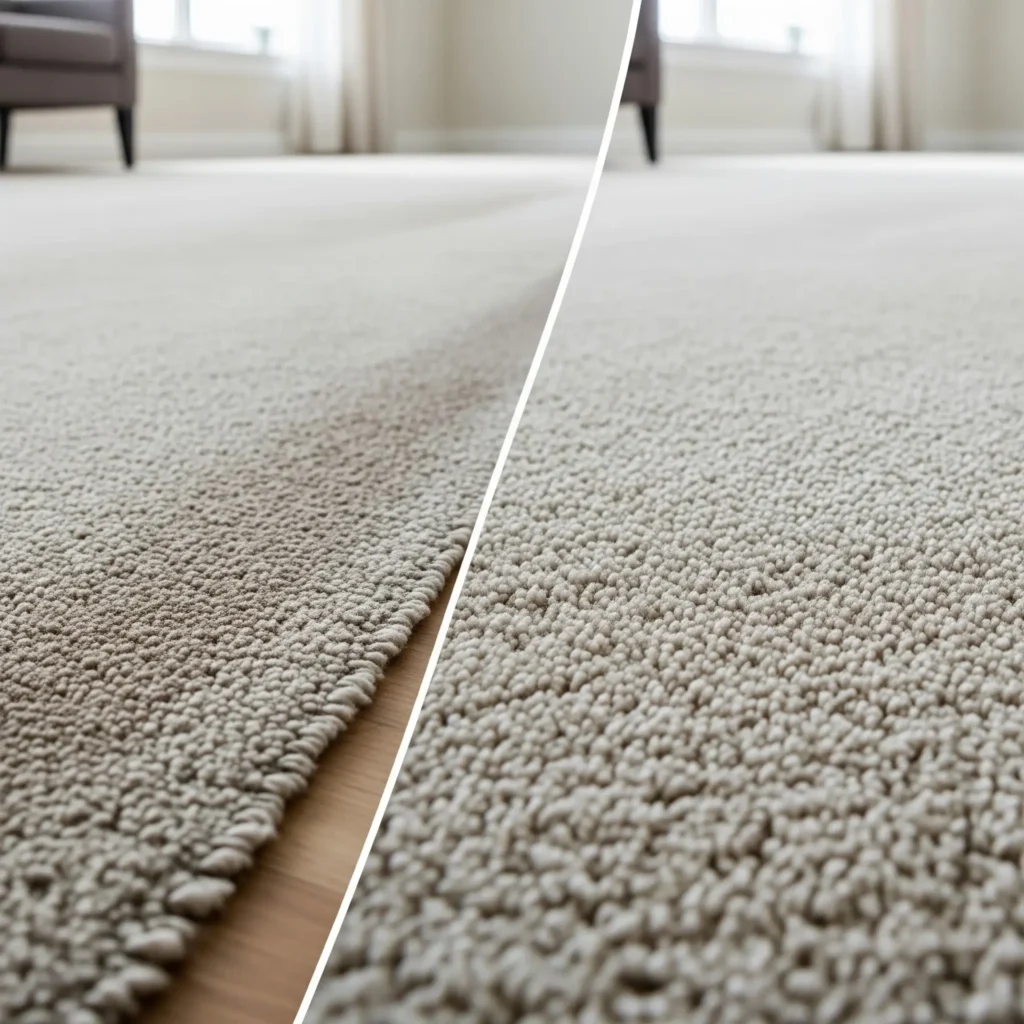
The matting you see in traffic lanes isn’t just cosmetic. Once the fiber structure collapses, no professional cleaning brings it back. Cleaning cleans — it doesn’t restore the fiber’s twist or pile height. If your carpet looks clean right after a hot water extraction but mats flat again within two weeks, the pile is structurally compromised.
Watch for these specific signals:
- Permanent traffic lanes: High-traffic areas look visibly lower and darker than surrounding carpet even after cleaning.
- Rippling or buckling: Carpet that has developed waves or ridges across an open floor area has stretched past re-stretch recovery. In Billings, this often comes from extreme humidity swings pulling at carpet installed without proper acclimation.
- Persistent odor after cleaning: Pet dander, cooking smells, and tracked-in soil that have reached the padding are impossible to fully address from the surface. Once the pad is saturated with pet waste or contaminated by black water, the carpet above it typically needs to go as well. Pads that have simply lost density from age may be replaceable without removing the carpet, if the carpet fiber itself is structurally sound.
- Visible fiber fraying at seams: Seam separation in a dry climate accelerates once it starts.
Most quality carpet in a Billings home, with good padding and proper maintenance, performs well for eight to twelve years in moderate-traffic areas. In active households, main corridors and living rooms typically show wear at the shorter end of that range. If you’re at or past that window and the signs above apply, the timing is right.
“Quite honestly, one of the best experiences I have ever had buying anything, period. Astasia was so incredibly helpful on the phone compared to every other store in the area. Once I arrived, she walked me through the different flooring options she thought were right for me, and showed me all the samples and colors she thought my wife and I would like — she nailed it. There was zero pressure involved, only genuine help and care for my family and their needs.”
Jordan R. — Billings, MT — Flooring Selection & Installation
Sign 3: Your Luxury Vinyl Plank Is Peeling, Bubbling, or Fading
Luxury vinyl plank has become the most popular flooring choice in Billings for one good reason: it’s 100% waterproof and handles humidity swings better than wood-based products. But LVP is not maintenance-free, and it has its own failure modes specific to our climate.
UV fading is the first thing to watch for. Billings sits above 3,000 feet elevation and gets over 300 days of sunshine per year. LVP exposed to direct south or west-facing window light fades and discolors faster than manufacturers’ specs, which are written for average elevations. A product rated for 15 years of UV resistance in a Chicago home may show noticeable fading in eight years in a Billings sunroom or west-facing living room.
Bubbling and delamination in the core of a plank usually means moisture got under the floor during installation or crept in afterward through an inadequately sealed expansion gap. Most floating LVP manufacturers specify a minimum 1/4-inch perimeter gap, with additional clearance required as the room size increases. In large open-plan rooms or long hallways, check your product’s spec sheet for run-length requirements, which can call for 3/8 inch or more.
In a Billings home where the floor sees a 70-degree temperature swing between summer and winter, an insufficient perimeter gap means the floor has nowhere to expand. The planks buckle up at the joints like a sidewalk heaving after a hard freeze.
Peeling on the wear layer is a different problem. It usually means the original product was a lower-grade entry-level LVP, or it was cleaned repeatedly with harsh chemicals that degrade the urethane finish. Once the wear layer starts peeling, the floor is done.
Billings homes built or renovated between 2015 and 2020 often have first-generation LVP products now reaching the natural end of their wear layer warranty period. The 2026 product generation is significantly better: thicker wear layers, better UV inhibitors, and improved locking systems that handle thermal movement more gracefully.
See our current flooring inventory for in-stock options across every category, including LVP built for Montana conditions.
Sign 4: Your Tile Is Hollow, Cracked, or Showing Grout Deterioration
Walk across your tile floor and tap individual tiles with your knuckle. A solid sound means the tile is well-bonded to the substrate. A hollow, drum-like sound means the tile has debonded from the mortar bed underneath.
Hollow tile is not an immediate structural failure, but it is a clock ticking toward cracked tile and an expensive repair. The longer you wait, the more surrounding tiles get pulled into the failure as the stress redistributes across the floor.
In Billings, tile debonding happens for a predictable set of reasons. The dominant soil types under much of Yellowstone County, including the expansive clay-bearing Haverson and Farnuf series soils common in the Billings flats, are prone to seasonal shrink-swell movement. A foundation or slab that moves even slightly under a rigid tile installation creates micro-stress at every bond point. Over time, those stresses accumulate and the tile releases.
Freeze-thaw cycles from our typical 64-day winter freeze period accelerate this in any area where moisture can reach the subfloor — garages, covered patios, and mudrooms being the most common victims.
Watch for these specific failure signs:
- Hairline cracks running diagonally across a single tile: Usually stress cracking from subfloor deflection or movement.
- Grout crumbling or missing in sections: Grout is not structural, but absent grout allows water to migrate to the mortar bed. Once the mortar gets wet repeatedly in a freeze-thaw zone, you will lose tile.
- Grout darkening uniformly: Can indicate ongoing moisture under the floor, especially in bathrooms and mudrooms.
- Tiles that shift or click when walked on: The bond is gone. These tiles will crack, and the ones around them are likely to follow.
A widely cited industry threshold holds that hollow tiles covering more than 25% of a floor area typically require full removal and reinstallation rather than spot repair. The National Tile Contractors Association provides detailed guidance on bonded mortar coverage standards. Spot-repairing isolated tiles in an otherwise failing installation is a short-term fix in Billings’ climate.
Sign 5: Your Subfloor Is Soft, Squeaky, or Uneven
This is the sign homeowners most often discover after they’ve already decided to replace the floor above it. A soft spot or a visible dip in an otherwise flat floor are clear subfloor warning signs.
Squeaks alone are often just fastener movement in the framing and are not necessarily a structural concern. The combination of a squeak with softness underfoot, visible deflection, or a musty odor is the pattern that points to genuine subfloor damage.
Subfloor damage in Billings homes has three main causes. The first is moisture intrusion from plumbing leaks, appliance failures, or ground moisture in basements and crawlspaces. The second is rot from years of tracked-in snow and salt water working through seams at exterior transitions — entryways, mudrooms, sliding door thresholds. The third is delamination of plywood subfloor panels from repeated wet-dry cycles.
OSB subfloors, which became standard in many Billings new construction and remodel projects from the 1990s onward, are particularly vulnerable to moisture. OSB swells when wet, the surface fibers separate, and once it has cycled through enough moisture events, it loses its structural integrity. You’ll feel it as a spongy give when you walk across it, distinct from the sharp tap of normal fastener movement.
Replacing flooring over a compromised subfloor without addressing the subfloor first guarantees the new floor fails prematurely. A proper pre-installation subfloor assessment identifies problems before they become surprises. Our team includes this as a standard step in every project estimate, and our licensed and insured installers are experienced in subfloor preparation before any new product goes down.
If you’re noticing any of the above signs, getting a free in-home measurement and assessment from an experienced local team is the right first step, not a Google search for the cheapest square-foot price.
What Does Flooring Replacement Cost in Billings, MT?
Pricing varies based on material, room conditions, subfloor prep requirements, and product tier. The ranges below are 2026 estimates for typical Billings residential projects, drawn from regional contractor pricing data. All prices include material and professional installation.
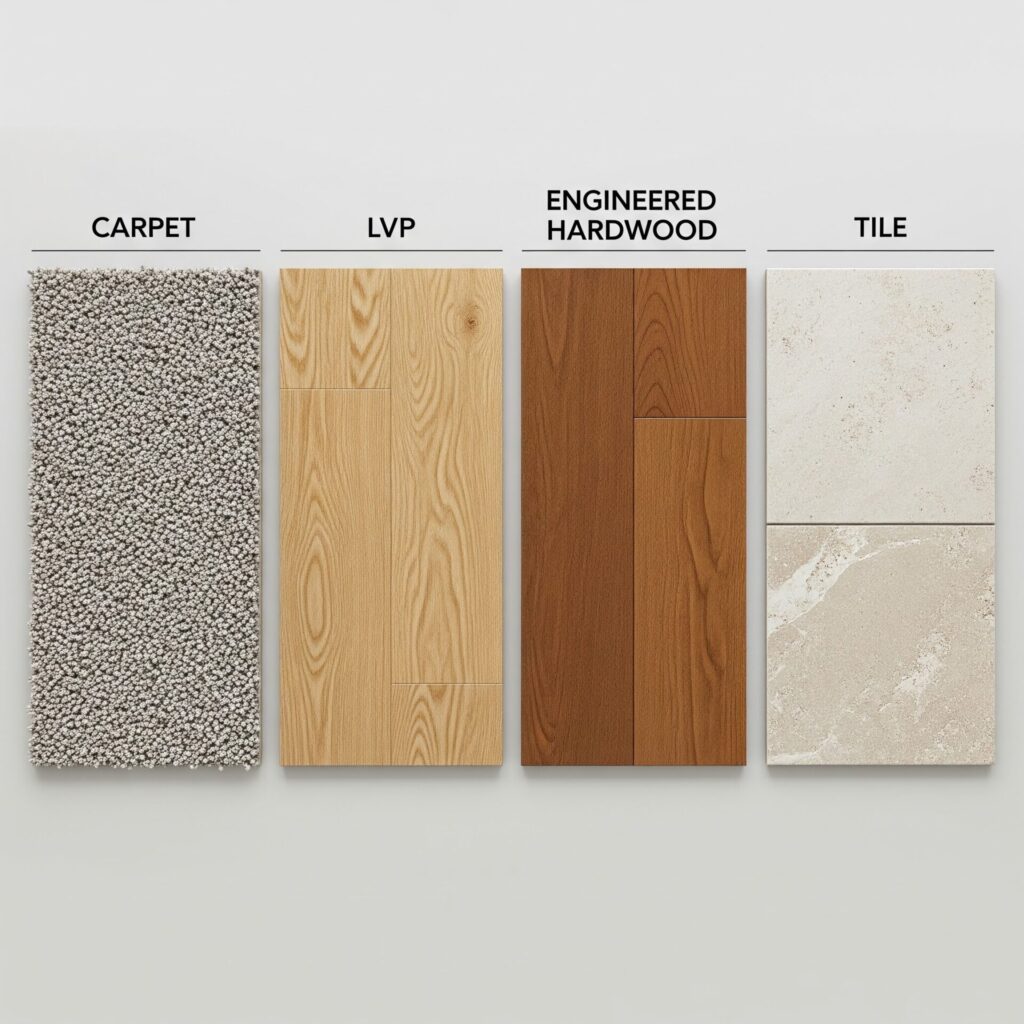
|
Flooring Type |
Material (per sq ft) |
Labor (per sq ft) |
Total Installed (per sq ft) |
Billings Notes |
|---|---|---|---|---|
|
Carpet (mid-grade) |
$1.50 – $3.50 |
$1.00 – $1.50 |
$2.50 – $5.00 |
Pad upgrade recommended for Billings dry climate; improves insulation and lifespan |
|
Luxury Vinyl Plank |
$2.00 – $5.00 |
$1.50 – $2.50 |
$3.50 – $7.50 |
12-mil wear layer for low-traffic rooms; 20-mil for kitchens, mudrooms, and pet households. UV inhibitors matter at our elevation |
|
Laminate |
$1.50 – $3.50 |
$1.50 – $2.00 |
$3.00 – $5.50 |
Waterproof core recommended; standard laminate does not hold up to tracked-in moisture |
|
Engineered Hardwood |
$4.00 – $9.00 |
$2.00 – $3.50 |
$6.00 – $12.50 |
Better humidity stability than solid hardwood for Billings climate swings |
|
Solid Hardwood |
$5.00 – $12.00 |
$3.00 – $5.00 |
$8.00 – $17.00 |
Requires humidity management; high ROI for resale |
|
Tile (ceramic / porcelain) |
$2.00 – $8.00 |
$4.00 – $7.00 |
$6.00 – $15.00 |
Subfloor prep critical over clay-bearing soils common in Yellowstone County |
Carpet (mid-grade)
Material (per sq ft)
$1.50 – $3.50
Labor (per sq ft)
$1.00 – $1.50
Total Installed (per sq ft)
$2.50 – $5.00
Billing Notes
Pad upgrade recommended for Billings dry climate; improves insulation and lifespan
Luxury Vinyl Plank
Material (per sq ft)
$2.00 – $5.00
Labor (per sq ft)
$1.50 – $2.50
Total Installed (per sq ft)
$3.50 – $7.50
Billing Notes
12-mil wear layer for low-traffic rooms; 20-mil for kitchens, mudrooms, and pet households. UV inhibitors matter at our elevation
Laminate
Material (per sq ft)
$1.50 – $3.50
Labor (per sq ft)
$1.50 – $2.00
Total Installed (per sq ft)
$3.00 – $5.50
Billing Notes
Waterproof core recommended; standard laminate does not hold up to tracked-in moisture
Engineered Hardwood
Material (per sq ft)
$4.00 – $9.00
Labor (per sq ft)
$2.00 – $3.50
Total Installed (per sq ft)
$6.00 – $12.50
Billing Notes
Better humidity stability than solid hardwood for Billings climate swings
Solid Hardwood
Material (per sq ft)
$5.00 – $12.00
Labor (per sq ft)
$3.00 – $5.00
Total Installed (per sq ft)
$8.00 – $17.00
Billing Notes
Requires humidity management; high ROI for resale
Tile (ceramic/porcelain)
Material (per sq ft)
$2.00 – $8.00
Labor (per sq ft)
$4.00 – $7.00
Total Installed (per sq ft)
$6.00 – $15.00
Billing Notes
Subfloor prep critical over clay-bearing soils common in Yellowstone County
Prices vary by room size, layout complexity, and subfloor condition. The biggest variable in Billings is subfloor prep: a room with an existing moisture problem or uneven substrate can add $1.00 to $3.00 per square foot before the new material ever touches the floor.
Seasonal labor demand also affects scheduling, with late spring and early fall being the busiest windows in the Yellowstone Valley.
Want a quote built around your actual space? Visit Our Showroom This Week or call (406) 656-2824. If you’re ready to move quickly, our Special Buys section carries factory-direct closeouts in every flooring category at prices that change monthly.
“One thing I always tell customers: don’t let the per-square-foot material price drive the whole decision. The floor that costs two dollars more per square foot but handles our humidity swings and doesn’t need replacing in seven years is the better value every time. We look at the full picture before we recommend anything.”
— Derrick Tokar, Store Manager, World Famous Carpet Barn
How to Maintain Your Floor Through Billings Winters and Summers
Regardless of which floor you have now or what you’re planning to install, Billings’ climate demands a seasonal maintenance mindset.
Winter (November through March) is the highest-risk season for floor damage. Salt and grit from roads and parking lots act as an abrasive on every surface. Use high-quality entry mats inside and outside every exterior door, and clean those mats weekly.
For hardwood and laminate floors, run a humidifier in the main living areas to keep indoor humidity above 35%. A hygrometer costs under twenty dollars and tells you exactly what your floors are experiencing. For LVP, use a damp mop only — standing water, wet mops, and steam mops can force moisture into seams and, for glue-down LVT, loosen the adhesive bond. No amount of surface moisture is harmless at the seam.
Spring (March through May) brings the highest tracked-in moisture volume of the year. Wipe hardwood entryways dry rather than letting moisture sit. Check expansion gaps around LVP and laminate perimeters, as planks that swelled during the wet season may need re-inspection. For tile floors, check grout joints in mudrooms and around exterior thresholds where freeze-thaw stress has been greatest.
Summer (June through August) drops indoor humidity to 40% and below. This is when solid hardwood floors are most vulnerable to gapping. Keep window coverings on south and west exposures during peak sun hours to protect LVP and hardwood from UV degradation. Summer is also the best season for any floor replacement project, as stable humidity conditions produce the best installation outcomes.
Fall (September through November) brings a fast transition from summer dry to winter wet, often in a single week in October. Inspect for signs of wear before the heating season begins, check carpet for odor retention, look for hardwood gaps that didn’t fully close from summer, and make sure exterior thresholds are fully sealed before the first hard freeze.
According to the NWFA, acceptable indoor humidity for hardwood is 35% to 55%. Billings homes routinely go well below that in winter. A basic whole-home humidifier connected to your furnace is one of the most cost-effective floor protection investments a Billings homeowner can make.
For all hard-surface floors including hardwood, LVP, laminate, and tile, use only pH-neutral cleaners. Vinegar solutions and ammonia-based products degrade urethane and aluminum oxide finishes over time, shortening the life of the wear layer and dulling the surface permanently.
“These people are incredibly helpful, kind, and patient. Great selection, fantastic prices. Service is fast and very good. Very good advice on color coordination and appropriate flooring types for different applications — residential, rental, commercial. Installation is fast and well done.”
Ed B. — Billings, MT — Flooring Selection & Installation
How to Choose a Flooring Installer in Billings and Surrounding Communities
Price shopping on flooring is reasonable. Price shopping on the installation is where Billings homeowners most often end up spending more in the long run.
Before signing any contract with a flooring installer in Billings or anywhere in southeastern Montana, ask these questions:
On subfloor assessment:
- Do you inspect the subfloor before providing a final quote?
- Do you take moisture readings at the slab or subfloor level before installation?
- What subfloor conditions would change your quote, and by how much?
A reputable installer takes moisture readings as a standard step, not an add-on. Skipping moisture testing is the single most common shortcut that leads to failed floors. In Billings, with our clay-heavy soils and aggressive seasonal moisture cycles, it is not optional.
On warranty:
- What does your installation warranty cover, and for how long?
- If a manufacturer defect appears two years after install, who do I call?
World Famous Carpet Barn backs every installation with a one-year workmanship warranty through the Pierce Promise, which also means we advocate directly with manufacturers on your behalf for product defects throughout the life of the floor. You’re not making warranty calls to an 800 number and hoping someone gets back to you.
On credentials:
- Are your installers licensed and insured in Montana?
- Can you provide references from Billings-area projects in the last twelve months?
Our installers are licensed and insured, and we’ve been doing this on Grand Avenue since 1972. World Famous Carpet Barn is also a member of the National Floorcovering Alliance, a buying group of independent retailers vetted for quality and service standards.
“Most of the calls we get after a flooring failure aren’t about the product itself. They’re about an installer who skipped the moisture test, didn’t pull the baseboards, or rushed the subfloor prep to hit a deadline. Those shortcuts don’t show up for six months. By then, the installer is long gone and the homeowner is left holding it.”
— Derrick Tokar, Store Manager, World Famous Carpet Barn
Red flags to avoid:
- Quote provided with no in-person site visit
- No mention of moisture testing
- Vague or verbal-only warranty
- No local references or verifiable project history
Billings has grown quickly, and national contractors who travel into the market for large developments don’t always bring the local knowledge that matters for residential work in Yellowstone County. Whether you’re in Billings, Laurel, Lockwood, or as far out as Miles City or Hardin, the experience that comes from 50 years in this region — working with these soils, this climate, and this building stock — makes a real difference in how a floor performs long-term.
Frequently Asked Questions
How much does flooring replacement cost in Billings, MT?
For a 1,500-square-foot home replacing all main-level flooring, expect a total installed cost between $5,250 and $18,750 depending on material choices and subfloor condition. Most Billings homeowners replacing carpet with LVP or mid-grade engineered hardwood land between $7,500 and $13,000 for that scope. Tile installations in kitchens and bathrooms run higher per square foot due to labor complexity, typically $6 to $15 per square foot installed. Always get an in-person quote — subfloor prep variables in Billings can shift a budget significantly.
Why do wood floors gap in Billings, MT winters?
Billings indoor humidity in a heated home during January and February can drop below 25%, well below the 35% to 55% range the NWFA recommends for hardwood. That moisture loss causes boards to shrink across the grain and gaps to appear at the seams. Small seasonal gaps that close fully in summer are generally normal. Persistent open gaps, cupped edges, or boards that feel soft or spongy underfoot indicate cumulative moisture damage that refinishing alone won’t correct.
How long does floor replacement take in Billings, MT?
The process starts with a free in-home measurement and consultation, where we assess your existing floor, take subfloor readings, and discuss product options that fit your lifestyle and budget. Once you select your product, we schedule installation. Most standard rooms take one to two days for carpet, LVP, and laminate, while hardwood and tile projects take longer depending on scope and subfloor prep. We handle furniture moving as part of the installation, and most residential projects are finished within two to four weeks from the date you place your order.
Should I replace or refinish my hardwood floors in Billings?
If the floor has enough wood above the tongue to sand (typically 3/16 inch or more) and the damage is surface-level, refinishing is a viable option. Cupped boards, significant gaps, soft spots underfoot, or finish lifting at the seams all point to replacement instead.
For carpet, if the pile is structurally matted, the pad is saturated or contaminated, or odor persists after professional cleaning, replacement is likely needed. If the pad has simply lost density and the carpet fiber is sound, pad replacement alone may restore performance. For LVP, a peeling wear layer or bubbling core requires replacement — refinishing is not an option for vinyl products.
Is LVP or hardwood better for Montana homes?
For most Billings homes, LVP is the more forgiving choice in rooms with moisture exposure: mudrooms, entryways, kitchens, and bathrooms. It’s 100% waterproof, handles temperature swings well with a floating installation, and requires less humidity management.
Engineered hardwood is the better choice where the warmth and refinishability of a real wood floor matter — living rooms, offices, and bedrooms where moisture exposure is controlled. It handles Billings’ humidity swings better than solid hardwood because the layered core is more dimensionally stable, but it still benefits from humidity management through winter. Our flooring team can walk you through both options with samples from brands we carry, including Shaw Floors, Mannington, Anderson Tuftex, and Kahrs.
Ready to Replace Your Floors? Start Here.
You don’t need to have decided what material you want before you come in. You need to know your floor is telling you something — and that’s enough to start the conversation.
World Famous Carpet Barn has been on Grand Avenue since 1972. Our team has seen every type of floor failure this climate produces, and we carry every major flooring category in our showroom so you can compare options side by side with people who know Billings specifically.
Stop in any day this week, no appointment needed.
World Famous Carpet Barn 2032 Grand Avenue, Billings, MT 59102 (406) 656-2824 | Toll-Free: (888) 738-2824 cbarn.com
Monday through Friday: 7:30 AM to 6:00 PM Saturday: 8:30 AM to 5:00 PM
Or schedule a free in-home consultation and we’ll come to you. Measurements and estimates are always free.
About the Author
Derrick Tokar — Store Manager, World Famous Carpet Barn
Derrick Tokar has spent over a decade on the floor at World Famous Carpet Barn, working directly with Billings homeowners, builders, and property managers across southeastern Montana. As Store Manager, he oversees product selection, installation quality, and customer consultations from initial measurement through final walkthrough. Derrick specializes in subfloor assessment, climate-appropriate product selection, and helping customers navigate the specific challenges that Billings winters and summers create for every flooring type. World Famous Carpet Barn is part of the Pierce Flooring family of brands, which has served Montana homeowners since 1924.