- LVP
- |
- Hardwood
Engineered Hardwood vs. LVP in Billings, MT: What Montana Homeowners Actually Need to Know
June 17, 2026
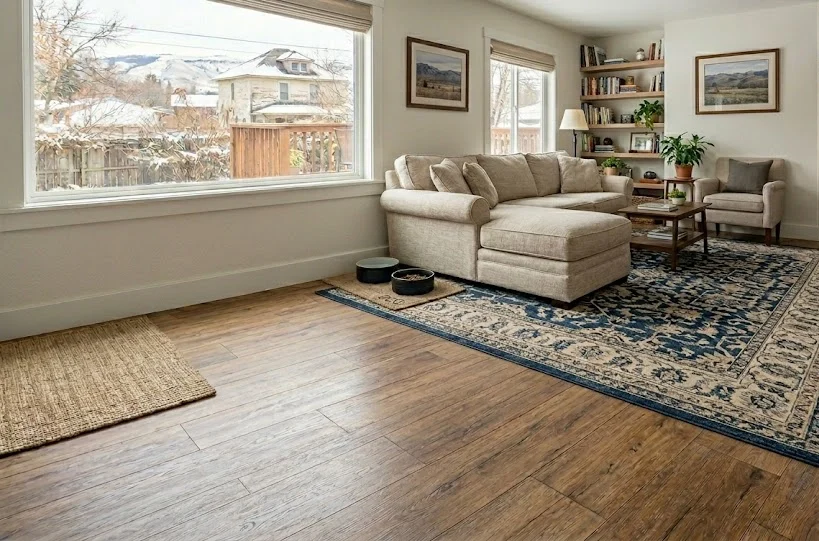
You’ve stood in a showroom and held both samples. They both look like wood. One feels warmer. One feels tougher. The salesperson was helpful, but now you’re home and still not sure which one belongs in your living room.
The national flooring websites won’t help you much here. They are written for the average American home — which is not a Billings home.
Call or visit World Famous Carpet Barn at 2032 Grand Ave and bring your subfloor details. The conversation is free, and in most cases, 15 minutes answers the question.
The team at World Famous Carpet Barn has been selling and installing both engineered hardwood and LVP in Billings homes for more than 50 years. They’ve seen both products succeed. They’ve also seen both products fail — almost always because of the subfloor, and almost always because the homeowner didn’t know what questions to ask.
Here is what they’d tell you before you decide.
Why Billings Homes Are a Different Conversation
The seasonal humidity swing inside a Billings home is one of the most significant flooring variables you’ll encounter anywhere in the region.
In summer, indoor relative humidity typically sits around 37-40%. Run the furnace from November through March, and that number can shift substantially — depending on how well the home is humidified, ventilation, and how airtight the building envelope is. That kind of seasonal swing, measured in terms of moisture content change in the wood, is what separates a floor that will hold up for two decades from one that starts gapping at year five.
Here in the Heights and on the West End, where new construction has moved fast over the past several years, we see engineered hardwood going into homes with clean concrete slabs. The subfloor is fine, the installation is done right, and the product performs beautifully. In older homes near downtown and the South Side — where slab moisture history is less predictable — a concrete subfloor that looks dry in June can test differently in April. That’s not a reason to avoid the product. It’s a reason to test before you buy.
What Engineered Hardwood Actually Is (and What Makes It Different Here)
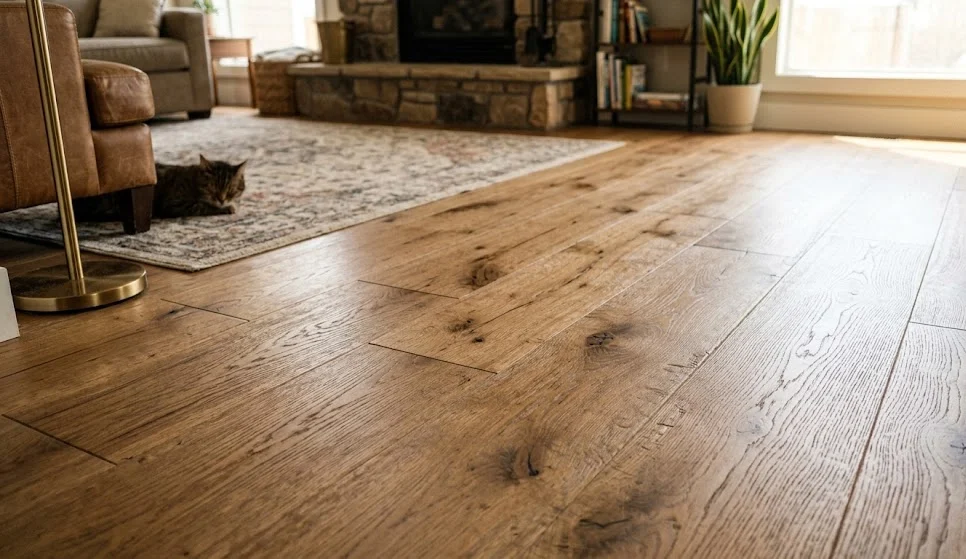
Think of engineered hardwood as a real wood surface mounted on an engineering problem.
The top veneer is genuine hardwood — the species, grain, and texture you’d get with solid wood. Below it, a cross-laminated core of plywood or high-density fiberboard stabilizes the plank against expansion and contraction. The cross-lamination means the layers resist movement in opposing directions simultaneously, which is the key reason engineered hardwood handles humidity swings better than solid wood.
The thickness of that top veneer is the most important number you’ll hear in the showroom. A wear layer of 2mm or more allows a full sand-and-refinish. At 3mm or more, the floor can be refinished multiple times. Below those thresholds, you’re looking at one very light pass with dustless equipment, and eventually, replacement rather than renewal.
For Billings homeowners who plan to stay in a home for 15 or 20 years, that refinishing potential is meaningful. It’s also one of the primary reasons engineered hardwood holds stronger resale appeal in the upper-end Billings market — buyers respond to real wood floors in a way they don’t to vinyl, even excellent vinyl.
What engineered hardwood cannot do is handle standing water. It is not waterproof, and any subfloor moisture that isn’t diagnosed before installation will show itself eventually.
What LVP Actually Is (and Why Montana Winters Make It Compelling)
LVP is synthetic from top to bottom, and in Montana, that is partly a feature.
Modern luxury vinyl plank uses emboss-in-register technology — the surface texture is aligned precisely with the printed grain pattern, which is how it avoids the flat, slightly wrong look of older vinyl products. Quality products from manufacturers like Shaw, which Carpet Barn carries as an authorized dealer, are convincing enough that most guests won’t identify them as vinyl unless they’re on their knees looking at the edge of a plank.
The core is either SPC (stone polymer composite) or WPC (wood polymer composite). For Billings homes, SPC is usually the better choice. SPC has a lower thermal expansion coefficient — around 0.05% — compared to WPC’s 0.08%. In a market where a floor installed in July will face very different conditions in January, that difference in dimensional stability matters more than it does in a milder climate.
The honest trade-off: LVP will never feel like real wood underfoot. It doesn’t have the same density or acoustic quality. Most people stop noticing after a few weeks. Some people never fully get over it.
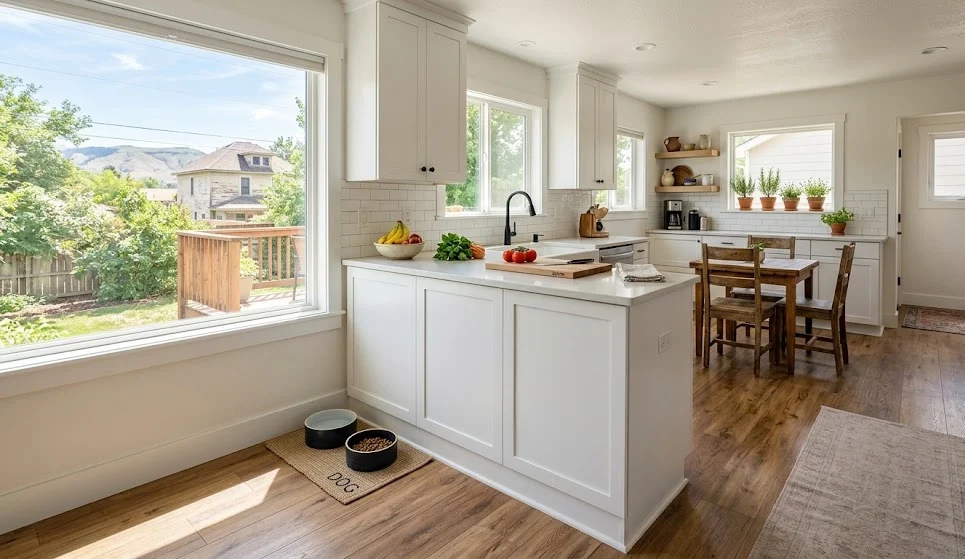
What LVP will do is handle road salt, mud, dog water bowls, and spring runoff without complaint. That’s worth a lot in Billings.
Engineered Hardwood vs. LVP in Montana: Where Each Product Wins
Honestly, most homeowners who are debating this question are already more than halfway to the right answer — they just haven’t named it yet.
Engineered hardwood is the better fit when:
You’re installing in an above-grade main living area (living room, dining room, hallway) with a wood subfloor and no moisture history.
You plan to stay in the home long enough to refinish the floor at least once — think 10-15 years out.
Resale in a higher-end listing is a factor, and you want floors that signal quality in listing photos.
LVP is the better fit when:
The subfloor is concrete, especially below grade.
The room takes real daily abuse: kitchen, mudroom, bathroom, entryway, or finished basement.
You have large dogs or young kids, and you’re already exhausted by the idea of worrying about the floor.
You want a floor that will look essentially the same in year 12 as it did in year 1, with minimal effort.
A lot of Billings families do both. Main living spaces get engineered hardwood for the warmth and character. Kitchen, mudroom, and bathrooms get LVP because that’s where Montana walks in the door. That split is practical, and it’s how a lot of the best-looking Billings homes are finished.
“I had a great experience shopping for new flooring at Carpet Barn. Friendly service and great prices. I purchased LVP flooring for my kitchen and can’t wait to have it installed. Would recommend the kind amd helpful employees at the Billings store.” – Edith H.
“In our experience, the homeowners who regret their choice almost always made it without checking the subfloor first. That test takes ten minutes and changes the entire conversation.” — World Famous Carpet Barn team, Billings, MT
Before You Buy Either Product: The Subfloor Check
The subfloor is where most flooring decisions go wrong in Billings — not the product selection.
Before installation, any quality installer should assess three things. First, moisture content in wood subfloors should be within 2-4% of the flooring being installed, per National Wood Flooring Association guidelines. Second, concrete slab moisture needs a calcium chloride test or relative humidity probe — especially in Billings, where spring thaw and older construction can create subfloor conditions that look dry and test otherwise. Third, flatness: no more than 3/16″ variation over a 10-foot span for floating installations, or 3/16″ over 6 feet for nail-down, per NWFA standards.
If you’re not sure about your subfloor, request a free in-home assessment at cbarn.com/contact-us/ before committing to either product. That step alone has saved more than a few Billings homeowners from an expensive mistake.
I am so satisfied with this service! Astasia really raised the bar on promptness. The small bedroom I needed carpeted was measured the day of my call, and upon seeing the room she made a recommendation for a remnant that ended up being ✨️perfect✨️ for this space.
Quotes were emailed to me the next day, and by the following day the carpet was installed! Their installation crew was efficient, considerate, and experienced.
I am beyond impressed and so happy with the plush, luxurious carpet that matches so well with the room colors. – Kennedy S.
“The subfloor question is the first thing we ask. We’ve seen beautiful engineered hardwood cupping in a house where the slab tested fine in September but held moisture from the previous spring. We don’t want that to happen to a customer’s new floor.” — World Famous Carpet Barn team, Billings, MT
How to Make the Call
Bring three things to your consultation.
A photo of the room — furniture, existing flooring, and natural light if possible. You can also try both products in your space before you visit using the Room Visualizer at cbarn.com/room-visualizer/.
Your subfloor situation — above-grade wood, or concrete? Any flooding or moisture history in the space?
Your household reality — dogs, kids, a mudroom that sees real Montana winter use? That context narrows the decision faster than any spec sheet.
World Famous Carpet Barn at 2032 Grand Ave is a member of the National Flooring Alliance (NFA), a vetted group of the top independent flooring dealers in North America. Browse the engineered hardwood collection and the full vinyl flooring lineup at cbarn.com, or call (406) 656-2824 to schedule your free in-home consultation and subfloor assessment.
Frequently Asked Questions
Is engineered hardwood better than LVP for Billings homes?
It depends on where you’re installing. For above-grade main living areas with a wood subfloor and no moisture history, engineered hardwood is a strong choice. For kitchens, bathrooms, basements, and anywhere with regular moisture or a concrete slab, LVP performs better in Montana conditions.
Can engineered hardwood be refinished?
Yes, if the wear layer is thick enough. A wear layer of 2mm or more allows a full sand-and-refinish. At 3mm or more, multiple cycles are possible. Always ask about wear layer thickness before purchasing, especially in Billings, where seasonal humidity swings accelerate surface wear over time.
Does LVP look as good as real wood?
Modern LVP from quality manufacturers is very convincing. The emboss-in-register technology aligns surface texture with the printed grain, which eliminates the flat vinyl look of older products. The feel underfoot is different from real wood, but most homeowners stop noticing the distinction after a few weeks.
Which floor holds up better with large dogs in a Billings home?
For large-dog households, LVP is generally the more practical choice. It is fully waterproof and more scratch-resistant than most engineered hardwood finishes. If you prefer engineered hardwood, choose a harder species (white oak, hickory) with a matte finish — matte hides minor scratches significantly better than satin or gloss.
How do I know if my subfloor is ready for engineered hardwood?
A professional installer should test moisture content before installation. In Billings, concrete slab subfloors are common and require either a calcium chloride test or a relative humidity probe before any wood-based product goes down. Carpet Barn’s free in-home measurement includes a preliminary subfloor check.
Does engineered hardwood add more resale value than LVP in Billings?
In most markets, buyers perceive real wood flooring — including engineered hardwood — as a stronger quality signal than luxury vinyl in main living areas. For higher-end Billings listings, engineered hardwood in the primary spaces is worth considering if the subfloor supports it and the budget allows.